








<Prepared Video, Sound> is an experimental performance that seeks to apply the concept of the prepared piano, which has been popularized by contemporary musicians and artists such as John Cage and Fluxus, to the audiovisual media of video and sound (Klang). Prepared Piano is a musical instrument that is transformed by placing various objects (clothespins, glass, soil, etc.) inside a traditional piano. Just as the sound result of playing the Prepared Piano is not semi-intentionally prepared, the work starts from the question of what is the 'unplanned/unprepared direction' of a video, which is considered to be born within an inherently planned structure, as a 'prepared video'. The work also contains an exploration of whether a video (precisely, a video that contains only visual information with auditory information removed)cannot be utilized as an auditory information or experience ('video sound')like sound.
Through the work, I invite the viewer to question the notion of 'preparation' and to rethink the concept of time, linguistic categories, and sensation. Inheriting John Dewey's' art as experience', I provide the viewer with an experience that allows them to sensually experience the process as it is. It is a continuation of my research into 'sensualization of process and context', improvisation, and genre experimentation.
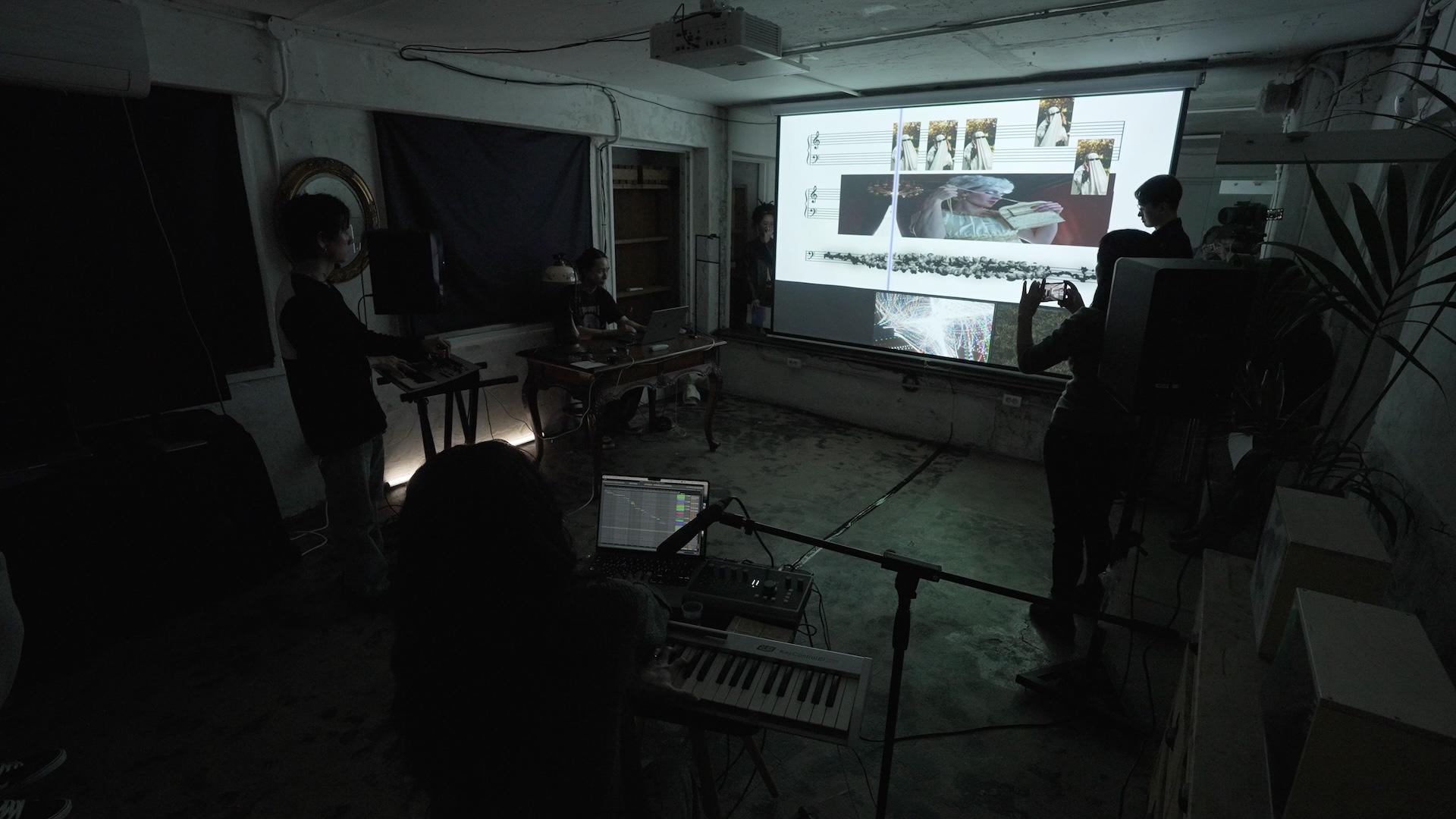
The most important component of the work is the 'video score'. The 'video score' is a linear, time-based score that provides abstract visual information for the performance by linking the live performance of the musicians with actual scores, texts, found footage, and graphic images. It is a video-evolutionary form of musical score utilized by Karlheinz Stockhausen, Stefan Prins, Nam June Paik, and others, which is closer to the language of the written word than the traditional pentatonic score or national musical notation.
There are genius pioneers who have created scores that are more advanced than those widely known to the public, or who have utilized scores in music. There were text and graphic scores by composers Henning Christiansen, Jorgen Lekfeldt, Henrik E Rasmussen, and Sejong Shin; mathematical score animations by motion designer Simon Russell; Alexander Schubert's use of the score (rules) itself as a synchronized audio-visual; scores composed of instructions written on paper, such as Nam June Paik's Fifth Symphony and Robot Opera; and visual listening scores by Rainer Wehinger. However, it has not been widely presented that the score is a video in digital form and the video acts as a component of the score. In this performance, I introduce a 'video score' that 'plays with time' and invites even the time being played to become a composition.
The 'video score' consists of a blue line, the Indicator, and a chronological sequence of images and videos. The Indicator calls for the musician to play, using it as the axis of the performance's rhythm (timing).
My 'video score' begins by distorting the score of Boulez's <Structure I> (1952) and utilizing asa source or 'note' the recordings Ligeti made when creating his work <Apparitions>(1959). This is not only an homage to Boulez and Ligeti's attempts to create scores and music in a gravity-free/weightless direction, but also an developmental/evolutionary alternative to Boulez's diagonal, mathematical musical form as a material, utilizing the time axis, which is a unique characteristic of video, to add a time axis to Boulez's musical axis. While the 'tape music' of contemporary music utilizes the concept of space to arrange the score in a linear fashion, the 'video score' goes beyond this and allows time itself to be played.
Since the output video is inherently chronological and linear in nature, if the output video acts as an element of the score - a note, if you will - then the musician cannot follow the indicator and play a first reading (looking at the score and playing it immediately) in the traditional sense. Notes have been consumed as 'set in stone', and when a musician reads a paper score, they naturally look and read from left to right. However, reading a video score requires (in a big way) Husserl's phenomenological exclusion. Simply put, it requires intuition, which is an attempt to break free from conservative dogmatism and improvise and intuitively embrace the notes and the score itself as a holistic experience. To observe is also to interpret. By taking the moving visual information for whatit is and 'interpreting' it, musicians can perform a video score that representsa performance of time. However, this is not intended to destroy the tradition of the score, but rather to present it as an inherited and evolutionary alternative.
The visual results of my ongoing series <Video-Music Jamming> were actively utilized for <Prepared Video, Sound>, including the ‘video score’. Inspired by the practice of improvisation among musicians, <Video-Music Jamming> is an attempt to experiment with the possibilities of “improvisation” between video artists and musicians, to “play” music and video in an unplanned, mutually inspired way, and to study the aesthetics of the process. By utilizing <Video-Music Jamming>,not only can we find fun in the improvisation of improvised videos as musical notes, but it also becomes an element that can approach the basic question of questioning and exploring the concept of ‘preparation’, which is what we want to express through <Prepared Video, Sound>, i.e., the prepared, preparing, and prepared results. In addition, the video of <Video-Music Jamming> is responsible for the organization of the existence of 'video sound', another important component of <Prepared Video, Sound>.
In <Prepared Video, Sound>, a musician plays in time while reading a 'video score' usingthe video source created by ‘jamming’, and the frequency, key, etc. of the sound played by the musician are corresponded to by the functions (logic) of a computer program to express the video. Only the system for receiving and transmitting information is set up, but since the auditory information coming through the system is anomalous, the resulting visual information is also anomalous. In this case, the anomalous audiovisual video is defined as 'video sound'. A “video sound” is a single note played. Through this, the audience is accompanied by the experience of perceiving visual information in a similar form to auditory information through a synesthetic experience. In other words,'video sound' presents an ambiguous process experience that is closer to an auditory experience than a visual experience. The meaning of the ambiguous concept is multiplied and expanded by the use of the resulting <Video-Music Jamming>.The time of the corresponding video ('video sound') is distorted or decontextualized, and the audience's sense of time and sense is tested through the final result, which reveals the rearranged context.
Each artist performs according to a strictly scored format, but if the score is abstract, the prepared abstract “video score” and the prepared performance by the prepared score invite the audience to explore the expansion of the concept of preparation andits ambiguity. If the same score is later “performed” by different artists, the results will be different, and in this case, the process precedes the result in meaning. Through <Prepared Video, Sound>, we hope to provide a creative reflection on the concept of preparation and a sensory experience of the process as it is.
Through the work, I invite the viewer to question the notion of 'preparation' and to rethink the concept of time, linguistic categories, and sensation. Inheriting John Dewey's' art as experience', I provide the viewer with an experience that allows them to sensually experience the process as it is. It is a continuation of my research into 'sensualization of process and context', improvisation, and genre experimentation.
The most important component of the work is the 'video score'. The 'video score' is a linear, time-based score that provides abstract visual information for the performance by linking the live performance of the musicians with actual scores, texts, found footage, and graphic images. It is a video-evolutionary form of musical score utilized by Karlheinz Stockhausen, Stefan Prins, Nam June Paik, and others, which is closer to the language of the written word than the traditional pentatonic score or national musical notation.
There are genius pioneers who have created scores that are more advanced than those widely known to the public, or who have utilized scores in music. There were text and graphic scores by composers Henning Christiansen, Jorgen Lekfeldt, Henrik E Rasmussen, and Sejong Shin; mathematical score animations by motion designer Simon Russell; Alexander Schubert's use of the score (rules) itself as a synchronized audio-visual; scores composed of instructions written on paper, such as Nam June Paik's Fifth Symphony and Robot Opera; and visual listening scores by Rainer Wehinger. However, it has not been widely presented that the score is a video in digital form and the video acts as a component of the score. In this performance, I introduce a 'video score' that 'plays with time' and invites even the time being played to become a composition.
The 'video score' consists of a blue line, the Indicator, and a chronological sequence of images and videos. The Indicator calls for the musician to play, using it as the axis of the performance's rhythm (timing).
My 'video score' begins by distorting the score of Boulez's <Structure I> (1952) and utilizing asa source or 'note' the recordings Ligeti made when creating his work <Apparitions>(1959). This is not only an homage to Boulez and Ligeti's attempts to create scores and music in a gravity-free/weightless direction, but also an developmental/evolutionary alternative to Boulez's diagonal, mathematical musical form as a material, utilizing the time axis, which is a unique characteristic of video, to add a time axis to Boulez's musical axis. While the 'tape music' of contemporary music utilizes the concept of space to arrange the score in a linear fashion, the 'video score' goes beyond this and allows time itself to be played.
Since the output video is inherently chronological and linear in nature, if the output video acts as an element of the score - a note, if you will - then the musician cannot follow the indicator and play a first reading (looking at the score and playing it immediately) in the traditional sense. Notes have been consumed as 'set in stone', and when a musician reads a paper score, they naturally look and read from left to right. However, reading a video score requires (in a big way) Husserl's phenomenological exclusion. Simply put, it requires intuition, which is an attempt to break free from conservative dogmatism and improvise and intuitively embrace the notes and the score itself as a holistic experience. To observe is also to interpret. By taking the moving visual information for whatit is and 'interpreting' it, musicians can perform a video score that representsa performance of time. However, this is not intended to destroy the tradition of the score, but rather to present it as an inherited and evolutionary alternative.
The visual results of my ongoing series <Video-Music Jamming> were actively utilized for <Prepared Video, Sound>, including the ‘video score’. Inspired by the practice of improvisation among musicians, <Video-Music Jamming> is an attempt to experiment with the possibilities of “improvisation” between video artists and musicians, to “play” music and video in an unplanned, mutually inspired way, and to study the aesthetics of the process. By utilizing <Video-Music Jamming>,not only can we find fun in the improvisation of improvised videos as musical notes, but it also becomes an element that can approach the basic question of questioning and exploring the concept of ‘preparation’, which is what we want to express through <Prepared Video, Sound>, i.e., the prepared, preparing, and prepared results. In addition, the video of <Video-Music Jamming> is responsible for the organization of the existence of 'video sound', another important component of <Prepared Video, Sound>.
In <Prepared Video, Sound>, a musician plays in time while reading a 'video score' usingthe video source created by ‘jamming’, and the frequency, key, etc. of the sound played by the musician are corresponded to by the functions (logic) of a computer program to express the video. Only the system for receiving and transmitting information is set up, but since the auditory information coming through the system is anomalous, the resulting visual information is also anomalous. In this case, the anomalous audiovisual video is defined as 'video sound'. A “video sound” is a single note played. Through this, the audience is accompanied by the experience of perceiving visual information in a similar form to auditory information through a synesthetic experience. In other words,'video sound' presents an ambiguous process experience that is closer to an auditory experience than a visual experience. The meaning of the ambiguous concept is multiplied and expanded by the use of the resulting <Video-Music Jamming>.The time of the corresponding video ('video sound') is distorted or decontextualized, and the audience's sense of time and sense is tested through the final result, which reveals the rearranged context.
Each artist performs according to a strictly scored format, but if the score is abstract, the prepared abstract “video score” and the prepared performance by the prepared score invite the audience to explore the expansion of the concept of preparation andits ambiguity. If the same score is later “performed” by different artists, the results will be different, and in this case, the process precedes the result in meaning. Through <Prepared Video, Sound>, we hope to provide a creative reflection on the concept of preparation and a sensory experience of the process as it is.